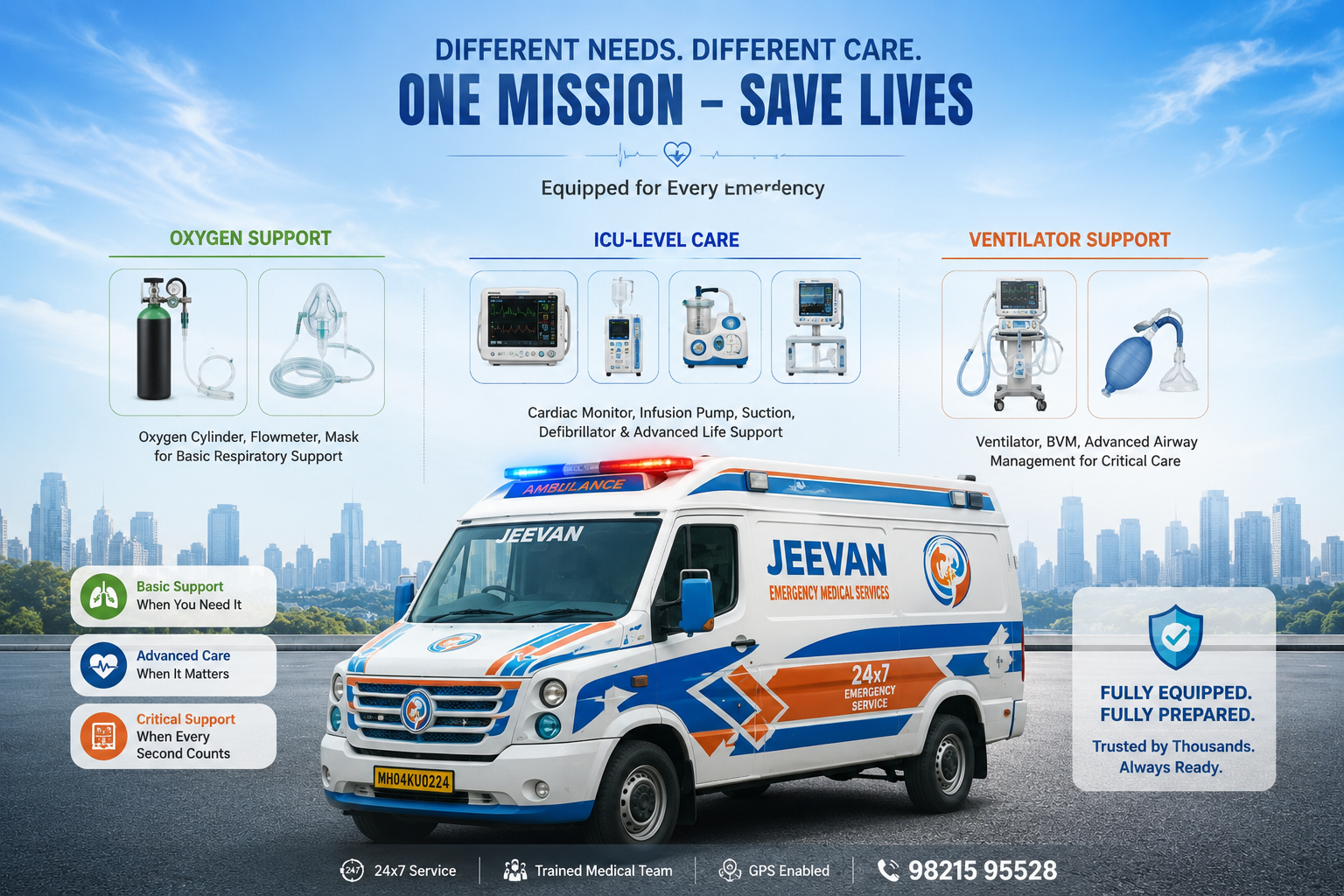
During a medical emergency, families often hear terms like oxygen ambulance, ICU ambulance, and ventilator ambulance. In panic situations, many people assume all ambulances provide the same level of care. However, every ambulance type is designed for a different medical condition and patient requirement.
Choosing the wrong ambulance can delay treatment, increase risk during transportation, and sometimes even worsen the patient’s condition. Understanding the difference between these ambulance services helps families make quicker and safer decisions when every minute matters.
In this article, we will explain the complete difference between oxygen ambulances, ICU ambulances, and ventilator ambulances, including their uses, facilities, and which one is suitable for different medical situations.
What is an Oxygen Ambulance?
An oxygen ambulance is a basic medical transport ambulance equipped with oxygen cylinders and essential medical support systems. It is mainly designed for patients who are stable but require oxygen assistance during transportation.
These ambulances are commonly used for patients experiencing mild breathing difficulties, elderly patient transfers, or hospital discharges where oxygen support is necessary but intensive care monitoring is not required.
Unlike advanced ambulances, oxygen ambulances do not function as mobile ICUs. Their primary purpose is to maintain oxygen levels and provide safe patient transport.
Facilities Available in an Oxygen Ambulance
Most oxygen ambulances include:
- Oxygen cylinders and oxygen masks
- Stretchers and wheelchairs
- Basic first-aid support
- Pulse oximeter for oxygen monitoring
- Trained ambulance staff
When is an Oxygen Ambulance Needed?
An oxygen ambulance is usually recommended when:
- The patient has low oxygen saturation
- Mild respiratory support is needed
- The patient is medically stable
- No ventilator or ICU monitoring is required
Patients suffering from asthma, COPD, mild pneumonia, or post-hospital recovery often use oxygen ambulance services for safe transportation.
What is an ICU Ambulance?
An ICU ambulance, also known as an Intensive Care Unit Ambulance, is an advanced life support ambulance equipped with critical care medical systems. It functions like a mini ICU on wheels and is designed for patients who require constant monitoring and emergency medical support during transportation.
ICU ambulances are used in serious medical emergencies where the patient’s condition can change rapidly during transit. These ambulances contain advanced equipment and trained paramedics capable of handling critical situations immediately.
Compared to oxygen ambulances, ICU ambulances provide significantly higher levels of medical care and monitoring.
Facilities Available in an ICU Ambulance
An ICU ambulance typically includes:
- Cardiac monitor
- Defibrillator
- Oxygen support system
- Infusion pumps
- Suction machine
- Emergency medicines
- Multi-parameter monitoring systems
- Advanced airway management equipment
- Critical care paramedics
Some ICU ambulances may also include doctor support depending on the patient’s condition.
When is an ICU Ambulance Needed?
ICU ambulances are commonly required for:
- Heart attack patients
- Stroke emergencies
- Trauma and accident cases
- Post-surgery critical transfers
- Organ failure patients
- Brain injury cases
- High-risk inter-hospital transfers
These ambulances ensure the patient remains stable throughout transportation while receiving continuous medical attention.
What is a Ventilator Ambulance?
A ventilator ambulance is one of the most advanced forms of emergency medical transportation. It is specially designed for patients who cannot breathe properly on their own and require mechanical ventilator support.
This type of ambulance includes all ICU ambulance facilities along with a portable ventilator machine that helps maintain breathing during transportation.
Ventilator ambulances are usually used for highly critical patients where even minor interruptions in breathing support can become life-threatening.
Facilities Available in a Ventilator Ambulance
A ventilator ambulance generally contains:
- Portable ventilator machine
- Advanced ICU setup
- Oxygen support
- Cardiac monitoring systems
- Defibrillator
- Suction apparatus
- Emergency medications
- Advanced airway management tools
- ICU-trained medical staff
These ambulances are specifically designed to maintain respiratory stability during long-distance or emergency patient transfers.
When is a Ventilator Ambulance Needed?
Ventilator ambulances are mainly required for patients suffering from:
- Severe respiratory failure
- Critical COVID complications
- Coma conditions
- Neurological emergencies
- Severe pneumonia
- ICU patients already on ventilator support
- Advanced lung infections
If a patient cannot maintain proper breathing independently, a ventilator ambulance becomes essential.

Key Difference Between Oxygen Ambulance, ICU Ambulance & Ventilator Ambulance
Although all three ambulances are used for patient transportation, the level of medical support provided in each vehicle is completely different.
An oxygen ambulance mainly focuses on oxygen delivery for stable patients. An ICU ambulance provides advanced critical care monitoring and emergency medical support. A ventilator ambulance offers complete ICU-level care along with mechanical breathing support for highly critical patients.
The major differences are based on:
- Level of medical equipment
- Patient condition severity
- Availability of ventilator support
- Critical care monitoring systems
- Medical staff expertise
Oxygen Ambulance vs ICU Ambulance
One of the most common online searches is “ICU ambulance vs normal ambulance.” Many people think an oxygen ambulance and ICU ambulance are similar, but there is a major difference in the treatment capability.
An oxygen ambulance only provides basic oxygen support and transportation facilities. On the other hand, an ICU ambulance is equipped to handle emergencies during transit with advanced monitoring systems and critical care equipment.
If the patient is stable and only needs oxygen, an oxygen ambulance is sufficient. However, if there is any risk of deterioration during transport, an ICU ambulance is the safer option.
- Click here to view: What to Do in the First 5 Minutes of an Emergency: A Lifesaver’s Guide
ICU Ambulance vs Ventilator Ambulance
A ventilator ambulance is more specialized than a regular ICU ambulance. While ICU ambulances provide advanced monitoring and emergency support, ventilator ambulances specifically focus on patients requiring artificial breathing assistance.
Not every ICU ambulance has a ventilator machine. Therefore, for patients already dependent on ventilator support, choosing a dedicated ventilator ambulance is extremely important.
Ventilator ambulances are generally used for the most critical patient transfer situations.
Which Ambulance Should You Choose?
Choosing the right ambulance depends entirely on the patient’s medical condition and the level of support needed during transportation.
An oxygen ambulance is suitable for stable patients needing oxygen assistance. An ICU ambulance is recommended for critically ill patients requiring constant monitoring. A ventilator ambulance is necessary when the patient depends on mechanical breathing support.
Doctors usually recommend the appropriate ambulance type based on the patient’s stability, oxygen levels, and emergency risk.
Why Choosing the Right Ambulance is Important
Medical transportation is not simply about shifting a patient from one location to another. The right ambulance ensures the patient receives uninterrupted medical care throughout the journey.
A properly equipped ambulance can:
- Prevent medical complications
- Maintain patient stability
- Provide immediate emergency intervention
- Improve survival chances during transport
- Ensure safer long-distance patient transfer
In critical situations, the quality of ambulance care can make a significant difference in patient outcomes.
Common Mistakes Families Make During Emergencies
During emergencies, families often make decisions based on urgency and cost rather than medical necessity. One of the biggest mistakes is assuming all ambulances provide ICU-level support.
Another common mistake is delaying ambulance booking while arranging alternatives. In severe medical emergencies, even a few minutes can become critical.
Families should always prioritize the patient’s medical condition over pricing and consult healthcare professionals before selecting an ambulance type.
Final Thoughts
Understanding the difference between oxygen ambulances, ICU ambulances, and ventilator ambulances is extremely important during medical emergencies.
An oxygen ambulance is ideal for stable patients needing oxygen support. An ICU ambulance provides advanced life-saving care for critically ill patients. A ventilator ambulance is specially designed for patients who require mechanical breathing assistance during transportation.
Choosing the correct ambulance not only ensures safer transport but can also significantly improve the patient’s chances of recovery and survival.
In emergencies, always select a professional ambulance service with trained medical staff and properly equipped vehicles to ensure the highest level of patient safety.