In medical emergencies, every second matters. Whether it is a heart attack, road accident, stroke, respiratory emergency, or critical patient transfer, delayed ambulance response can directly affect patient survival and recovery. In rapidly growing cities like Mumbai, Pune, Ahmedabad, and Surat, heavy traffic congestion often becomes one of the biggest challenges for emergency medical services. This is where GPS tracking technology has transformed modern ambulance operations.
Today, advanced ambulance services use GPS-enabled systems to reduce response time, identify the fastest routes, avoid traffic congestion, and ensure quicker medical assistance for patients. GPS tracking has become an essential part of emergency healthcare transportation, especially in urban areas where road conditions and traffic patterns change every minute.
What Is GPS Tracking in Ambulance Services?
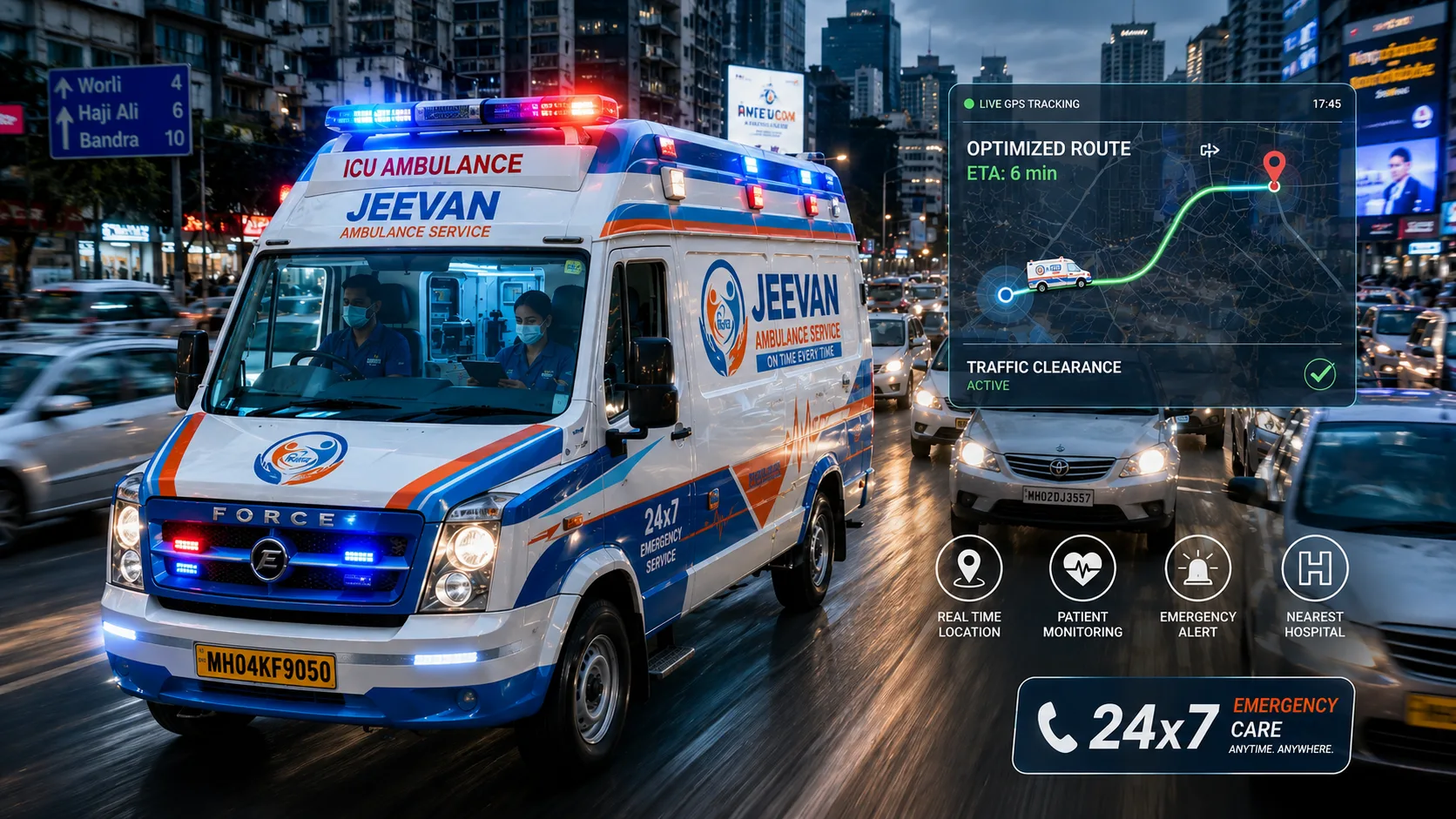
GPS tracking in ambulances refers to the use of Global Positioning System technology to monitor the real-time location of ambulance vehicles. Modern ambulance control rooms can track every active ambulance through centralized software systems that provide live updates about vehicle location, movement, estimated arrival time, and traffic conditions.
This technology allows ambulance dispatch teams to immediately assign the nearest available ambulance to a patient during an emergency call. Instead of manually coordinating routes or depending only on driver familiarity, GPS systems automatically identify the quickest and most efficient path to the destination.
In busy metropolitan cities where traffic congestion can delay emergency response, GPS tracking helps ambulance services improve operational efficiency and patient care.
Why Fast Ambulance Response Time Matters
Emergency healthcare heavily depends on timely intervention. Doctors often refer to the “Golden Hour” in trauma and emergency medicine, which highlights the importance of immediate medical care within the first hour of a serious medical incident.
Conditions such as cardiac arrest, severe bleeding, stroke, breathing difficulty, and major accidents require rapid emergency response. Even a delay of a few minutes can increase complications or reduce survival chances.
Urban traffic creates unpredictable delays due to:
- Peak-hour congestion
- Road construction
- Traffic diversions
- Signal delays
- Narrow roads
- High vehicle density
GPS tracking helps ambulance teams reduce these delays by continuously analyzing traffic movement and selecting faster alternative routes.
How GPS Tracking Improves Ambulance Efficiency
One of the biggest advantages of GPS-enabled ambulances is real-time route optimization. Traditional ambulance movement depended heavily on driver experience and local road knowledge. While experienced drivers remain extremely important, technology now supports them by providing live navigation updates based on current traffic conditions.
Modern GPS systems can:
- Detect traffic jams instantly
- Suggest alternative roads
- Calculate estimated arrival times
- Identify shortest available routes
- Monitor ambulance movement live
- Help dispatch teams coordinate multiple ambulances efficiently
This significantly improves emergency response management in crowded cities.
For example, if a major traffic blockage occurs on a primary road, the GPS system immediately reroutes the ambulance through faster connecting roads. This reduces travel time and allows paramedics to reach patients more quickly.
Better Coordination Between Ambulance and Hospital
GPS tracking also improves communication between ambulance teams and hospitals. Once an ambulance picks up a patient, hospitals can receive estimated arrival times in advance. This allows emergency departments to prepare medical equipment, ICU beds, trauma teams, or operation theaters before the patient arrives.
For critical patients requiring ventilator support or advanced life support systems, preparation time can make a major difference in treatment outcomes.
In many advanced ambulance systems, GPS tracking is integrated with ambulance dispatch software, enabling seamless coordination between drivers, paramedics, control rooms, and hospitals.
Real-Time Tracking Provides Transparency for Families
During medical emergencies, families often experience panic and uncertainty. GPS tracking helps improve transparency by allowing control rooms to provide accurate updates regarding ambulance arrival and patient transport status.
Some advanced ambulance services also provide live tracking links or estimated arrival times to patient families. This improves trust and reduces confusion during emergencies.
Knowing that the ambulance is actively moving toward the patient can provide reassurance during stressful situations.
GPS Tracking Supports Interstate and Long-Distance Patient Transfers
GPS technology is not only useful for local emergency calls but also for long-distance ICU ambulance transfers and interstate patient transportation.
Critical care transfers often involve:
- Ventilator support
- Oxygen management
- Cardiac monitoring
- Continuous medical supervision
GPS tracking helps ambulance operators monitor travel progress continuously and ensure timely coordination with receiving hospitals across different cities or states.
Long-distance patient transport becomes safer and more organized when routes are optimized in real time.
The Role of GPS in Smart Ambulance Systems
Modern ambulance services are increasingly adopting smart emergency response systems powered by technology. GPS tracking is now part of larger ambulance management ecosystems that include:
- Digital dispatch systems
- Emergency response analytics
- Traffic prediction tools
- Fleet management software
- Real-time communication systems
These technologies help ambulance companies maintain faster response times while improving patient care quality.
As Indian cities continue to grow, smart ambulance technology will become even more important in reducing emergency healthcare delays.
GPS Tracking Helps Save Valuable Time During Emergencies
In emergency medical services, time directly impacts patient survival. Even a few minutes saved during ambulance dispatch and transportation can improve the chances of successful treatment.
GPS tracking helps ambulance services:
- Reach patients faster
- Reduce delays caused by urban traffic
- Improve route planning
- Coordinate with hospitals efficiently
- Enhance emergency response accuracy
For patients experiencing life-threatening medical conditions, faster ambulance arrival can make a critical difference.
Conclusion
Urban traffic remains one of the biggest challenges for emergency healthcare transportation in India. However, GPS tracking technology has significantly improved the way modern ambulance services operate. By enabling real-time navigation, faster dispatch coordination, smarter route selection, and improved hospital communication, GPS systems help ambulances respond more efficiently during emergencies.
As cities become more crowded and healthcare demands continue to increase, technology-driven ambulance services will play a vital role in saving lives. Choosing an ambulance provider that uses advanced GPS tracking and modern emergency response systems can ensure quicker medical assistance when every second matters most.
For reliable emergency medical transportation, advanced ICU ambulance services, and fast response support, Jeevan Ambulance Service continues to provide professional emergency care solutions across multiple cities in India.