Emergencies do not wait for anyone, and when they arrive, they often arrive suddenly. In those critical moments, the decisions taken within the first few minutes can strongly influence the outcome. One of the most important decisions is choosing the right ambulance service. In India, where every city, district and region has a different level of medical infrastructure and traffic conditions, selecting the right ambulance provider matters far more than most people realise. An ambulance is not just a vehicle it is a moving medical support system capable of saving a life even before the patient reaches the hospital.
Today, India has multiple types of ambulances available: Basic Life Support ambulances, Advanced Life Support ambulances, ICU-equipped ambulances, neonatal ambulances for newborns, patient transport vehicles, train ambulances for long-distance medical transfers, and air ambulances for urgent inter-city or interstate movement. But most people do not know which one to choose in which situation, and that confusion often results in delays. In fast-moving emergencies like cardiac arrest, stroke, severe injury, respiratory distress or unconsciousness delays can be extremely dangerous. That’s why understanding ambulance types and selecting the right service is essential for every family.
Understanding Why Choosing the Right Ambulance Matters
A competent ambulance service does far more than simply take a patient from point A to point B. It provides immediate medical attention during the most crucial minutes of an emergency. A well-equipped ambulance with trained paramedics can stabilize a patient, manage vital functions, start oxygen therapy, control bleeding, perform CPR, administer life-saving medication and monitor the patient continuously while en route to the hospital. This early intervention can significantly improve survival and recovery.
In India, where road traffic is unpredictable and distances can be long, the quality of the ambulance team and the medical equipment inside the vehicle are essential. A good ambulance service ensures fast response, reliable communication, professional staff and the right type of vehicle for the specific emergency.

How to Identify a Reliable Ambulance Service in India
When choosing an ambulance provider, families should first check its reputation, availability, service network and medical capability. An established ambulance service maintains a strong fleet that covers multiple zones of the city, ensuring faster arrival times. Services that operate 24/7 with a dedicated emergency call centre tend to respond quicker because they dispatch vehicles immediately and track them in real time.
A trustworthy ambulance service will have trained emergency medical technicians (EMTs), paramedics, nurses or doctors depending on the type of ambulance. These professionals are trained to handle cardiac distress, trauma, neurological emergencies, respiratory issues, and other critical conditions. Their presence in the ambulance ensures that treatment does not wait until the patient reaches a hospital it begins the moment the patient is inside the vehicle.
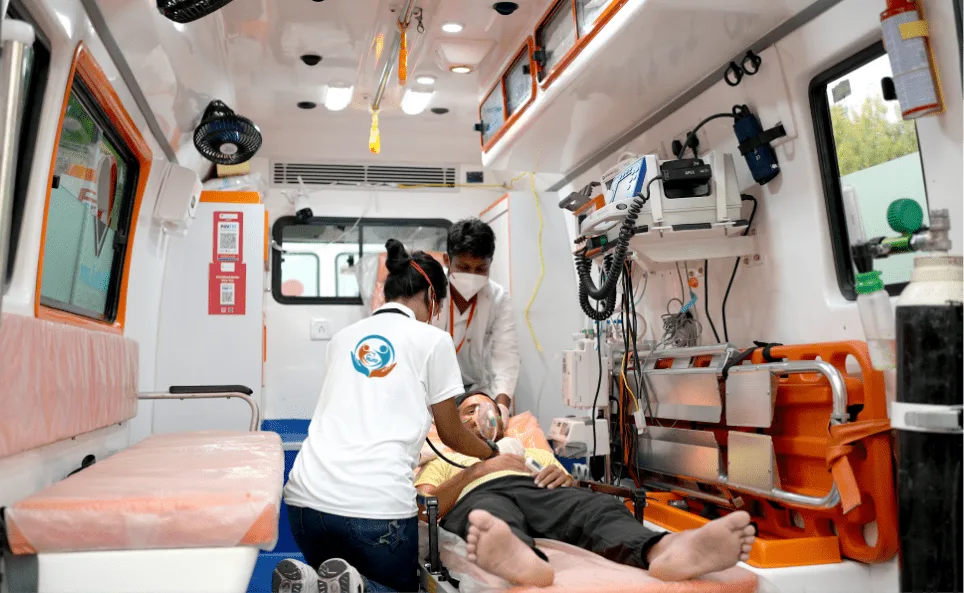
The equipment inside the ambulance is equally important. Depending on the ambulance type, this can include oxygen cylinders, airway support equipment, cardiac monitors, defibrillators, suction machines, infusion pumps, ventilators, neonatal warmers and advanced trauma kits. When a caller describes the patient’s condition to the control room, the operator should be able to decide which type of ambulance is needed and dispatch it quickly.
Understanding Which Type of Ambulance You Should Call
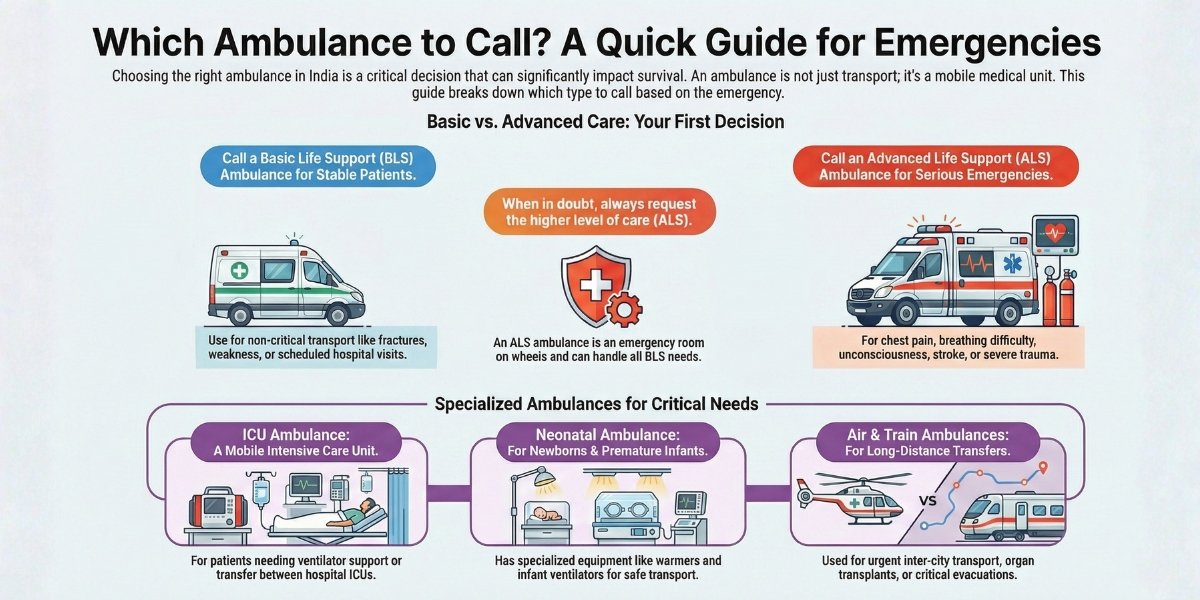
One of the biggest challenges families face is not knowing which ambulance type to request. In India, not all ambulances are the same, and choosing the wrong one can delay treatment. A Basic Life Support (BLS) ambulance is useful when the patient is stable but still needs supervised medical transport for instance, during fractures, weakness, dehydration, fever-related issues, or scheduled hospital visits. These ambulances typically have oxygen support, a stretcher, basic monitoring equipment and trained medical technicians.
However, when the emergency is serious such as chest pain, difficulty breathing, unconsciousness, stroke symptoms, seizures, severe trauma, bleeding or a sudden collapse it is always safer to request an Advanced Life Support (ALS) ambulance. ALS units come equipped with ventilators, cardiac monitors, defibrillators, oxygen supplies, life-saving medications and a trained paramedic or doctor who can handle complex emergencies during transit. An ALS ambulance is essentially a small emergency room on wheels.
In extremely critical cases, such as when the patient requires ventilator support, continuous ICU monitoring or advanced medication administration, an ICU ambulance becomes essential. These ambulances also transport patients moving from one hospital ICU to another, or those who are post-surgery and require close supervision.
For newborns or premature infants, a Neonatal Ambulance (NICU on wheels) is necessary because it carries specialized warmers and neonatal ventilators designed for infants. A regular ambulance is not equipped to handle fragile newborns safely.
For long-distance medical transportation especially when road travel is not possible or too risky India now has Train Ambulances and Air Ambulances. Train ambulances offer a safe, economical long-distance option for stable but supervised transport, while Air Ambulances are used in time-sensitive cases like organ transplants, inter-state transfers, critical patient evacuation or when rapid travel is essential.
How to Know Which Ambulance You Need During an Emergency
The easiest way to decide is to understand the patient’s condition. If the patient is conscious, breathing normally and not in a critical state, a BLS ambulance is usually sufficient. But if the patient is unconscious, gasping, having chest pain, bleeding heavily, recovering from ICU treatment, or requires urgent advanced medical help, you should always request an ALS or ICU ambulance.
When in doubt, always choose the higher category, because ALS ambulances can handle everything a BLS ambulance can—but also much more. Trained staff can respond faster and stabilise the patient until reaching the hospital.
Preparing for Emergencies Before They Happen
Most families search for an ambulance only after something goes wrong, which causes panic and confusion. It is wiser to select a trusted ambulance provider in advance. Save their emergency number on your phone under “Ambulance – Emergency” so that you don’t waste time searching online during stressful situations.
Also, share the number with family members, neighbours and elderly relatives. If your apartment complex, workplace or event venue regularly requires medical coverage, it is better to partner with a reliable ambulance service that provides on-premises medical standby or facility cover.
Why Not Every Ambulance Service Is Safe
In India, some ambulances operate without proper certification, medical equipment, or trained staff. While they may function as transport vehicles, they cannot provide professional emergency care during transit. Choosing such services increases risk, especially during critical emergencies. A poorly equipped ambulance may not have oxygen cylinders, defibrillators, emergency medication or trained staff who know how to respond. That is why relying on a well-established ambulance network with verified credentials is essential for patient safety.
Emergencies are unpredictable, but your response doesn’t have to be. When you know the difference between ambulance types and how to select a reliable service, you are better prepared to take control in a crisis. Whether it is a road accident, a medical emergency, a cardiac event, a newborn needing special transport, or a long-distance transfer through train or air, the right ambulance service ensures that medical care begins immediately and continues through the journey.
By choosing a trusted ambulance provider with trained professionals, modern equipment, a fast-response system, and a wide network of road, rail and air ambulances, families can significantly increase the chances of survival and ensure safer outcomes for their loved ones.